
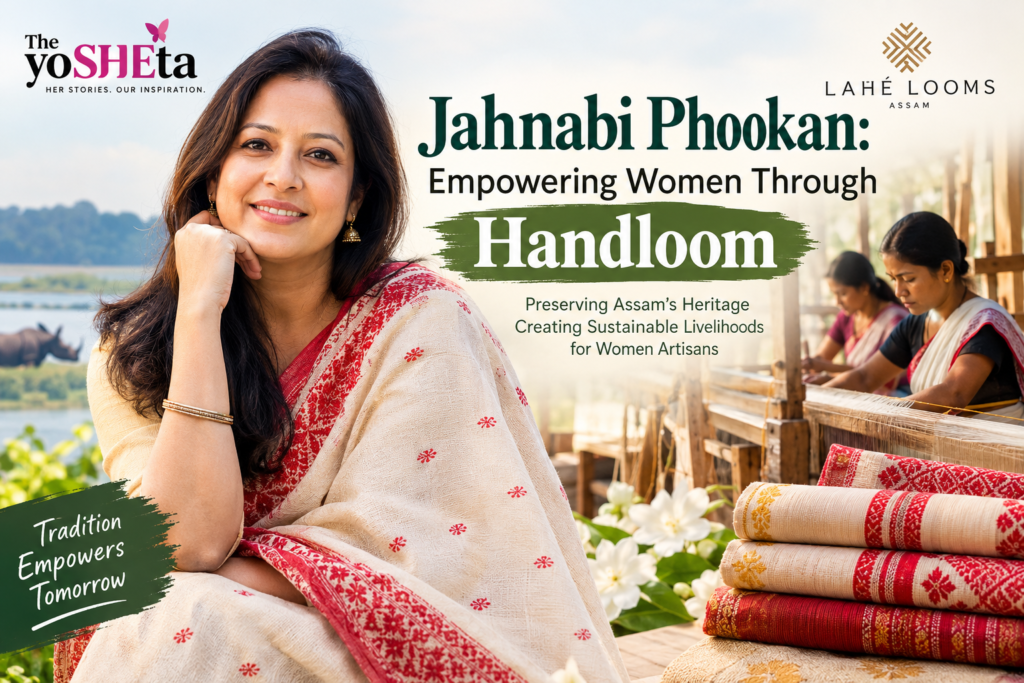
Jahnabi Phookan: The Entrepreneur Empowering Women Through Assam’s Handloom Heritage
How the founder of Lahé Looms is preserving traditional weaving, supporting women artisans and building a business with purpose.
In Assam, where handwoven textiles carry generations of cultural knowledge, entrepreneur Jahnabi Phookan is building a business that connects traditional craftsmanship with women’s economic empowerment.
As the founder of Lahé Looms, Phookan has dedicated part of her professional journey to preserving Assam’s distinctive handloom and silk traditions while creating livelihood opportunities for women weavers. Her work demonstrates how entrepreneurship can go beyond commercial success to create meaningful social impact.
In 2026, she was named among the winners of the Meaningful Business 100 (MB100), an initiative recognising leaders who combine business with positive social and environmental impact.
From Tourism Entrepreneurship to Women’s Empowerment
Jahnabi Phookan brings decades of experience in tourism and promoting Assam and Northeast India. She has been associated with Jungle Travels India and Assam Bengal Navigation Company, ventures connected with tourism and hospitality.
Her work in these sectors reflects a long-standing connection with the region’s cultural and natural heritage. Her contribution, however, extends beyond tourism into women’s livelihoods and traditional craftsmanship.
Through her involvement with women’s business networks, including the FICCI Ladies Organisation (FLO), Phookan has supported initiatives focused on women’s entrepreneurship and economic participation.
Lahé Looms: Where Traditional Craft Meets Social Purpose
Phookan’s work in the handloom sector has included efforts to develop weaving skills among women affected by human trafficking, helping them work towards rehabilitation and income-generating opportunities.
She has also worked with rural women weavers, supporting their craft through improved yarn and design inputs. In 2011, she established a residential weaving centre for migrant women weavers in Assam, near Kaziranga National Park.
These efforts form an important part of the story behind Lahé Looms, an enterprise that connects traditional Assamese weaving with contemporary markets.
The word Lahé means “slow” in Assamese. The name reflects an approach that values craftsmanship, thoughtful production and the cultural traditions behind every woven piece.
Preserving Assam’s Rich Silk Heritage
Assam is known for its distinctive silk traditions, including Muga, Eri and Pat silk. These textiles represent an important part of the state’s cultural identity and craftsmanship.
Through Lahé Looms, Phookan promotes traditional Assamese weaving techniques, indigenous motifs and natural dyes. The enterprise brings together regional silk, weaving communities and contemporary textile design.
Its products include sarees, mekhela sadors, dupattas, stoles, shawls and other handwoven creations.
By connecting traditional craftsmanship with modern markets, Lahé Looms seeks to keep these skills relevant to changing consumer preferences while creating opportunities for artisans.
A Farm-to-Fashion Approach to Sustainable Business
Lahé Looms follows a farm-to-fashion approach that connects silk sourcing, weaving, design and finished products. This model places importance on the origins of raw materials and the communities involved in production.
By promoting regional silk, traditional weaving and thoughtful production, the enterprise contributes to conversations around sustainable fashion and the preservation of indigenous crafts.
It demonstrates how a traditional industry can find new opportunities without losing the cultural identity that makes it distinctive.
Leadership Beyond Her Own Enterprise
Phookan’s commitment to women’s empowerment has extended into wider business leadership. She served as the national president of the FICCI Ladies Organisation (FLO) during 2020–21.
Her professional journey has included work across tourism, hospitality, textiles and women’s business networks. These experiences highlight the importance of connecting local communities with wider business opportunities.
Meaningful Business 100: International Recognition in 2026
Jahnabi Phookan was recognised among the 2026 Meaningful Business 100 winners. The initiative celebrates leaders who use business to address social and environmental challenges.
Reports on the announcement stated that this year’s winners were selected from more than 900 nominations. The initiative considers themes such as impact, innovation, leadership, equity and scalability.
Phookan’s work with Lahé Looms reflects these themes through its focus on women artisans, traditional knowledge, sustainable textiles and community livelihoods.
The Bigger Lesson: Empowerment Through Opportunity
Women’s empowerment is often discussed in terms of education, employment and leadership. Jahnabi Phookan’s work offers another perspective: creating economic opportunities around skills that women already possess or can develop.
Traditional crafts are not simply remnants of the past. They can also become sources of income, entrepreneurship and cultural continuity when artisans have access to training, quality materials and markets.
For women whose livelihoods depend on handmade products, the difference between possessing a skill and earning a sustainable income can be significant.
A Legacy Woven Into the Future
Jahnabi Phookan’s journey connects entrepreneurship, cultural heritage, sustainable fashion and women’s economic independence.
Through Lahé Looms, she is helping bring Assam’s handloom traditions into contemporary markets while supporting the women whose skills keep those traditions alive.
Her recognition among the 2026 Meaningful Business 100 winners offers an opportunity to highlight businesses that seek to create value not only through sales, but also through the opportunities they create for communities.
When women are given opportunities to turn their skills into sustainable livelihoods, the impact can reach far beyond the loom.
About The yoSHEta
The yoSHEta celebrates women whose stories, ideas and achievements inspire progress, strengthen communities and create opportunities for future generations.