Inspiration
Dr Sowmini Sunkara From Farm Gate to Global Markets
Oct 1, 2026 | By the yosheta
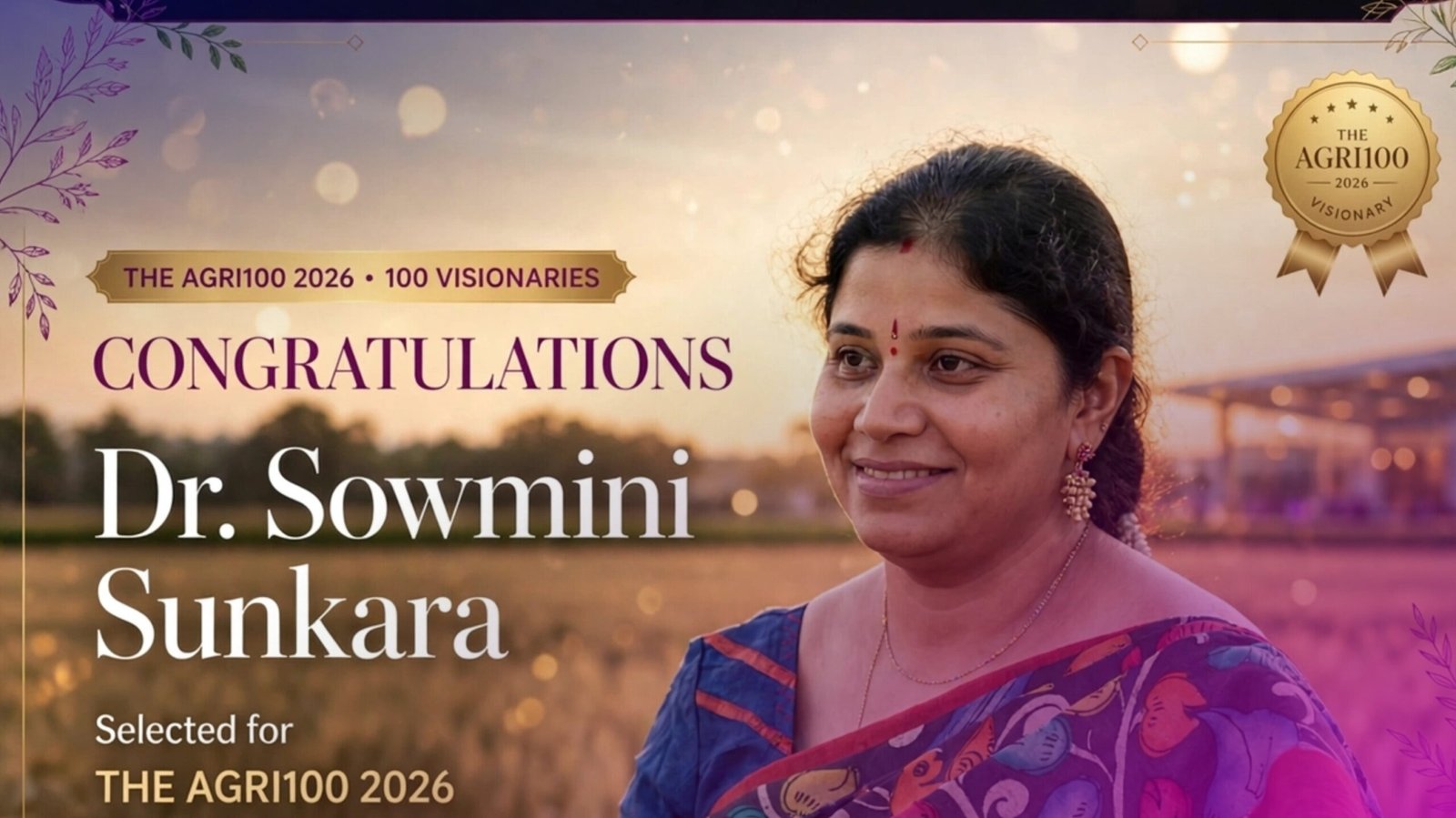
How Dr. Sowmini Sunkara Is Building a New Model for Rural Women’s Enterprise
An Exclusive Editorial Feature by THE yoSHEta Desk
For generations, rural women have been at the heart of agriculture—planting, harvesting, processing and sustaining families and communities. Yet, in many traditional value chains, they have had limited ownership of the businesses and profits created from that work.
Dr. Sowmini Sunkara is working to change that equation.
As Managing Director associated with Agrighar, WEAIM and WEMART Global, Dr. Sunkara’s approach focuses on taking rural communities beyond raw agricultural production and towards processing, manufacturing, branding and market access.
Her larger vision brings together technology, entrepreneurship, training and market linkages to create opportunities for women and youth within rural economies.
From Farming to Manufacturing
One of the central challenges in agriculture is what happens after the crop leaves the farm.
When farmers sell raw produce without sufficient processing or value addition, much of the economic opportunity can move further down the supply chain.
Dr. Sunkara’s model places greater emphasis on decentralised food processing, with the aim of bringing value addition closer to where agricultural produce is grown.
The proposed ecosystem connects four key pillars:
Agrighar
Food-processing and value-addition infrastructure designed to convert agricultural produce into market-ready products.
WEAIM
A women-focused manufacturing incubation ecosystem intended to help women enter areas that traditionally require technical, mechanical and industrial capabilities.
WEMART Global
A marketplace and trade-oriented platform focused on connecting women-led enterprises with wider domestic and international markets.
Agrighar Sustainable FoodTech Foundation
A foundation-oriented component focused on sustainable food systems, decentralised agro-clusters and reducing wastage across the agricultural value chain.
Together, these initiatives represent an approach that seeks to connect production → processing → entrepreneurship → markets.
‘empowHer’: Where Enterprise Begins
For Dr. Sunkara, infrastructure alone cannot create entrepreneurs.
Her empowHer initiative places mindset, identity, leadership and economic independence at the beginning of the entrepreneurial journey.
The philosophy is simple: before a woman can confidently manage machinery, negotiate with buyers or run a business, she must first see herself as someone capable of owning and leading that business.
Through conversations, learning programmes and entrepreneurial engagement, empowHer seeks to encourage women to move from being participants in economic activity to becoming decision-makers within it.
“Before you hand a woman a balance sheet or an industrial grinder, you must dismantle generations of conditioned self-doubt.”
That philosophy gives the larger ecosystem a human dimension. The machinery may create production capacity, but confidence and leadership determine who controls it.
One Local Unit, A Wider Market
A significant part of the Agrighar vision is decentralisation.
Instead of moving agricultural produce long distances before processing, the concept is to establish processing capabilities closer to farming communities.
Such units can potentially work with commodities including:
Millets
Pulses
Cereals
Spices
Cold-pressed oils
Flours
Fruits and vegetables
Herbal products
Ready-to-Cook and Ready-to-Eat foods
The proposed model can involve local entrepreneurs, Farmer Producer Organisations (FPOs), Self-Help Groups (SHGs) and other community institutions.
The objective is not simply to process food.
It is to ask a larger question:
Who owns the value created from the crop?
Building Entrepreneurs Through Udyam Kshetra
Rural entrepreneurship requires more than a one-day workshop.
The Udyam Kshetra framework brings together multiple stages of learning, exposure, mentoring and incubation.
Its six-level journey moves from basic awareness towards enterprise leadership:
Level 1 — Aarambh
Introduction to food and agribusiness opportunities.
Level 2 — Darshan
Exposure to operational food-processing environments and machinery.
Level 3 — Pragati
Structured agribusiness learning supported by digital and AI-enabled learning tools.
Level 4 — Jagruti
Mentoring, awareness and interaction with experienced professionals.
Level 5 — Siddhi
Advanced agribusiness specialisation and hands-on technical learning.
Level 6 — Nirmaan
Enterprise incubation, business development, government-scheme mapping, market linkages and institutional support.
The underlying idea is to create a journey from learning to leadership.
From India to International Collaboration
The model has also moved beyond India.
Agrighar has engaged with the State Government of Jigawa, Nigeria, through a Memorandum of Understanding aimed at developing youth and women-focused agribusiness initiatives.
For rural economies across the Global South, the challenges can often look remarkably similar: limited processing infrastructure, post-harvest losses, restricted market access and insufficient opportunities for rural youth and women.
This makes decentralised value addition an area of growing relevance—not only for India, but for other agricultural economies as well.
Recognition and Visibility
Dr. Sunkara’s work has received recognition and media visibility through several platforms and organisations.
These include the AGRI100 recognition by Krishi Jagran in 2026, the Global Women in Business & Leadership Award in 2025, and recognition/features associated with IRRI, CRISP, FoxStory India and YourAgristory.
THE yoSHEta Perspective
At THE yoSHEta, we believe women's empowerment becomes meaningful when it creates ownership, capability and economic agency.
That is what makes Dr. Sowmini Sunkara’s approach noteworthy.
The bigger story is not simply about a food-processing machine.
It is about a rural woman learning to operate that machine.
It is about understanding food-safety standards.
It is about negotiating with a buyer.
It is about packaging a product under a local brand.
It is about managing accounts, understanding markets and making business decisions.
And ultimately, it is about moving from being part of someone else’s value chain to becoming an owner within it.
If rural women can gain access to technology, manufacturing skills, capital, markets and leadership opportunities, agriculture can become more than a source of livelihood.
It can become a platform for rural enterprise creation.
From the farm gate to the processing unit, from the village entrepreneur to the global marketplace, Dr. Sowmini Sunkara’s work represents one possible pathway towards a more decentralised and women-led rural economy.
Connect with the Movement
General & Business Enquiries:
manager@agrighar.com | +91-9963176269
Incubation & Training Admissions:
trainings@agrighar.com | +91-7675835004
Official Portals:
agrighar.com | weaim.org | wemartglobal.in
THE yoSHEta — Women. Stories. Impact.