
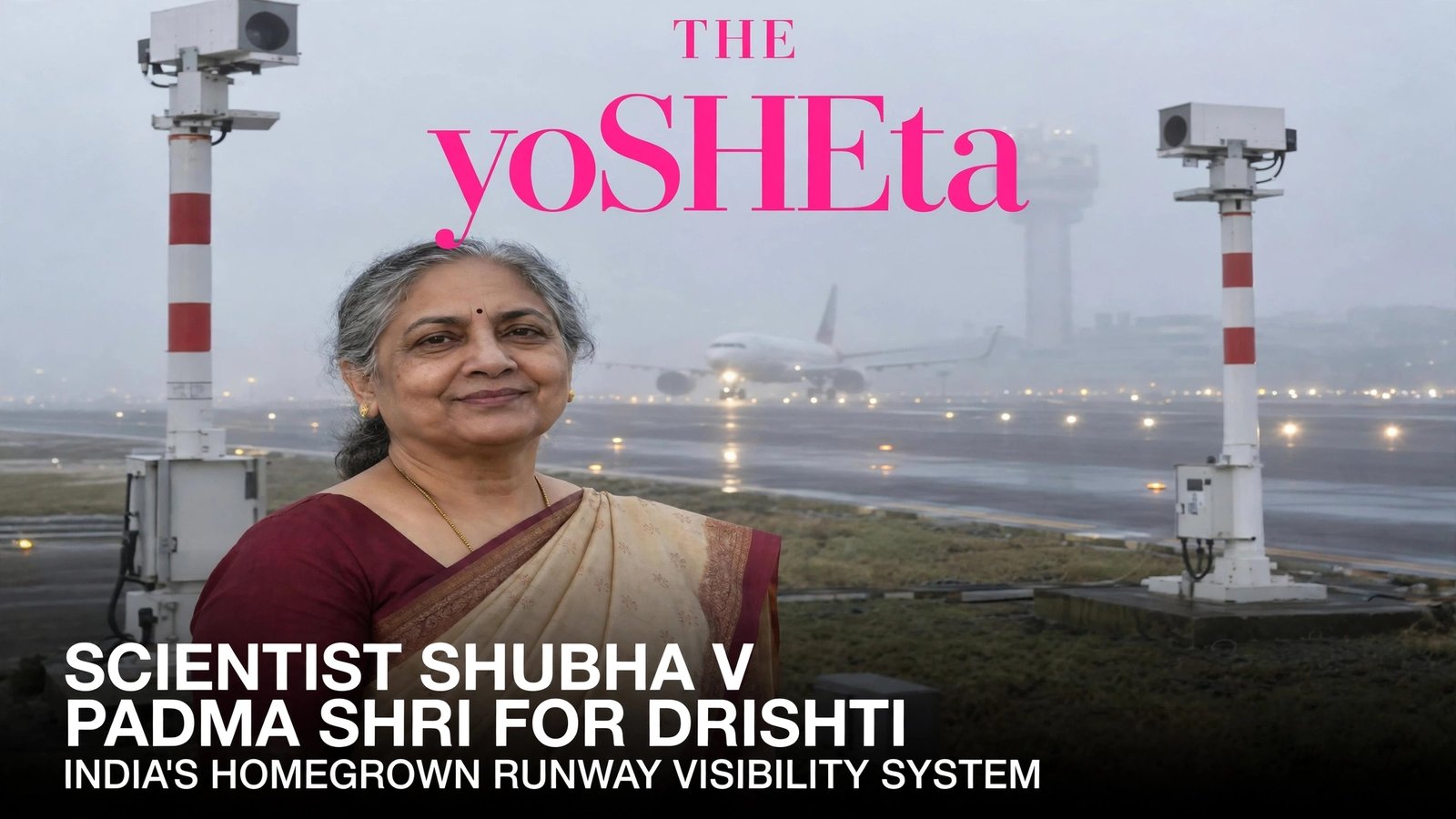
From Research to Runways: Dr. Shubha V. Iyengar and India’s Indigenous DRISHTI System
A pioneering woman scientist, decades of research and an innovation that strengthened India’s technological self-reliance. Dr. Shubha V. Iyengar’s Padma Shri 2026 recognition celebrates her contribution to science and engineering.
When fog covers an airport runway, visibility becomes one of the most critical factors in aviation safety. Pilots need accurate information about runway visibility to make informed decisions during landing and take-off.
Also read From a ₹300 Oven to a ₹7,900 Cr Market Valuation: Rajni Bector
Behind one of India’s important technological developments in this field is a woman scientist whose work helped reduce the country’s dependence on imported technology.
Meet Dr. Shubha V. Iyengar, the scientist associated with the development of DRISHTI, India’s indigenously developed runway visibility measuring system. Her contribution to science and engineering has been recognised with the prestigious Padma Shri 2026.
DRISHTI: An Indian Solution to an Aviation Challenge
Before the development of DRISHTI, Indian airports depended on imported technologies for measuring runway visibility.
These systems play an important role in aviation, particularly during challenging weather conditions such as fog and mist. Accurate visibility measurements help airport authorities and pilots assess runway conditions and make operational decisions.
Also read Raji Ashok Auto Akka: Making Chennai Safer for Women
Recognising the need for an indigenous solution, scientists at the CSIR–National Aerospace Laboratories (CSIR-NAL), Bengaluru, worked towards developing a system suited to India’s aviation requirements.
The result was DRISHTI, an indigenous runway visibility measuring system that uses transmissometer technology to measure atmospheric visibility and provide runway visual range information.
What Makes DRISHTI Special?
DRISHTI represents an important milestone in India’s journey towards technological self-reliance.
- Indigenous innovation: Developed in India as an alternative to imported runway visibility measuring systems.
- Cost advantage: Reported to cost approximately one-third of comparable imported systems.
- First installation: Installed at Delhi Airport in 2011.
- National recognition: Received the Make in India National Award in 2015.
- Wider application: Also used at Indian Air Force airports.
The development demonstrated that Indian research institutions could create specialised aerospace technologies to address important real-world requirements.
A Journey Built on Research and Persistence
Scientific innovation rarely happens overnight. It requires years of research, experimentation, engineering expertise and continuous improvements.
Dr. Shubha V. Iyengar’s association with CSIR-NAL reflects the importance of sustained scientific research and the contribution of scientists working behind the scenes.
Developing an aviation technology system requires precision and extensive technical understanding. DRISHTI stands as an example of what dedicated research and institutional collaboration can achieve.
While passengers may never think about the technology measuring runway visibility, such innovations play an important role in supporting aviation operations.
Why Her Recognition Matters for Women in STEM
Science, technology, engineering and mathematics need greater representation of women, particularly in specialised research and engineering fields.
Dr. Shubha V. Iyengar’s recognition offers an important message to young women considering careers in science and technology.
Women can lead scientific research, solve complex engineering challenges and contribute to technologies that serve the entire nation.
Her journey reminds us that scientific achievement is not always about being in the spotlight. Sometimes, it means spending years solving a problem that millions of people may never even know existed.
For young girls dreaming of becoming scientists, engineers and innovators, her story is an example of what curiosity, dedication and perseverance can achieve.
Beyond an Award: A Contribution to India’s Future
The Padma Shri is among India’s highest civilian honours. The recognition of Dr. Shubha V. Iyengar in 2026 brings attention to the importance of indigenous scientific research and engineering innovation.
Her achievement represents more than an individual award. It highlights the value of investing in Indian research institutions, encouraging homegrown technologies and creating opportunities for women to contribute to scientific progress.
India’s future in science will depend not only on the technologies it develops but also on the people whose knowledge, determination and hard work make those developments possible.
Dr. Shubha V. Iyengar’s story reminds us that sometimes, changing the future begins with helping a nation see more clearly.
Celebrating Women Who Make a Difference
At THE yoSHEta, we believe women’s achievements deserve recognition, whether they make headlines or quietly transform the world around us.
Dr. Shubha V. Iyengar is one such inspiration. Her contribution demonstrates how scientific research can create practical solutions and strengthen India’s technological capabilities.
How many more Indian women scientists, engineers and innovators have made extraordinary contributions that deserve to be celebrated?
Let’s discover their stories and give their achievements the recognition they deserve.
THE yoSHEta | Stories • Strength • Success