From Waste Corn Cobs to a Global Award: How 13-Year-Old Lalita Srisai Made Science Meaningful
A young girl from Odisha transformed an agricultural waste material into an innovative water filtration concept, proving that meaningful discoveries can begin with the simplest observations.
Sometimes, extraordinary ideas begin with things that people overlook.
Also read From a ₹300 Oven to a ₹7,900 Cr Market Valuation: Rajni Bector
For 13-year-old Lalita Prasida Sripada Srisai from Odisha, one such overlooked material was the humble corn cob — something commonly discarded after the kernels are removed.
Instead of seeing it as waste, Lalita saw a possibility.
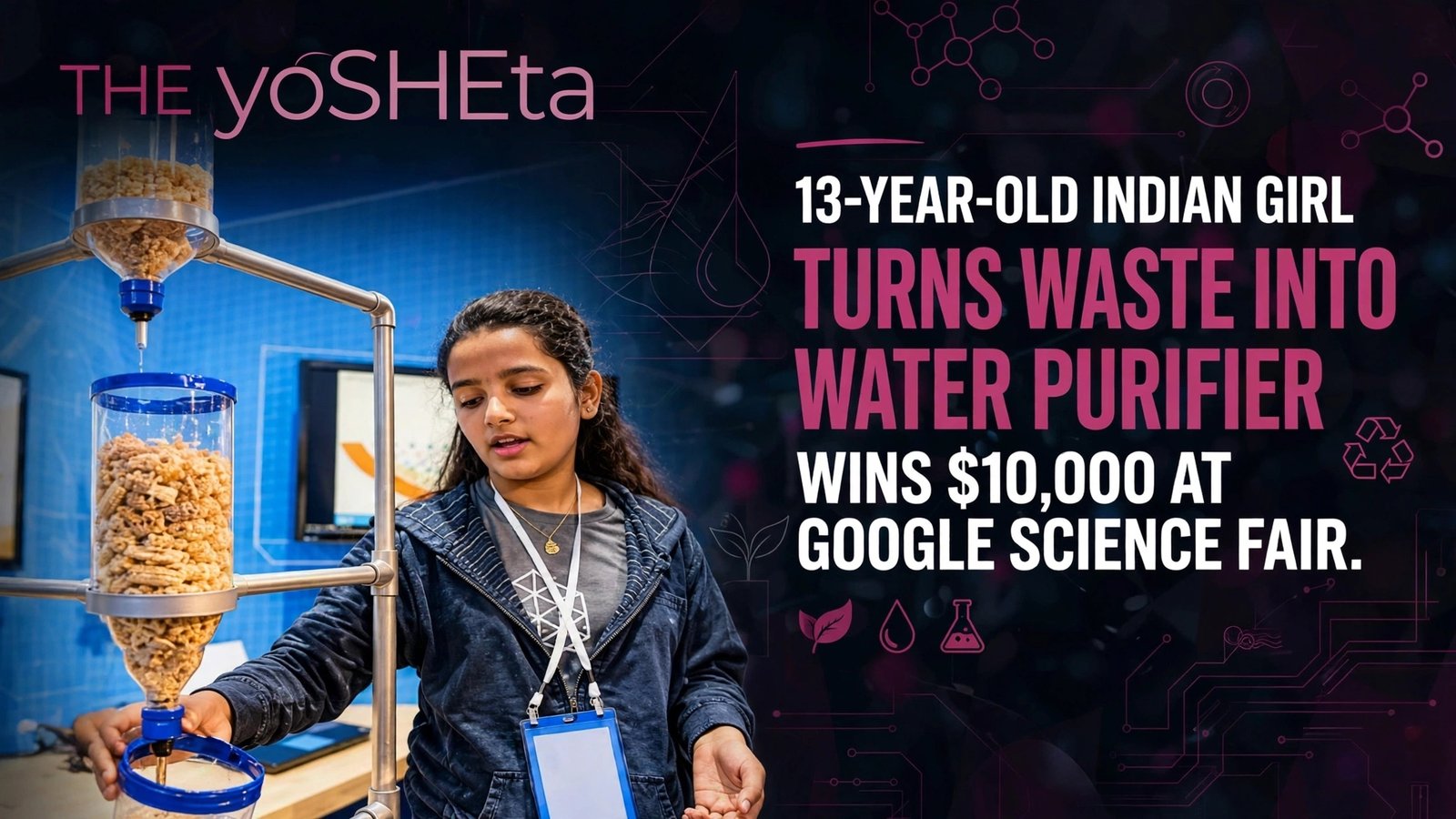
Her curiosity led her to develop a low-cost water filtration system using discarded corn cobs, an innovation that earned her international recognition at the 2015 Google Science Fair.
Her achievement was not just a personal milestone. It demonstrated how young minds can apply scientific thinking to environmental challenges and community needs.
Also read Raji Ashok Auto Akka: Making Chennai Safer for Women
An Idea Born From Everyday Observations
Lalita was a Class IX student at Delhi Public School, Damanjodi, in Odisha’s Koraput district.
While observing rural communities and agricultural practices, she became interested in two issues: the growing problem of water pollution and the large quantities of agricultural waste being discarded.
She began exploring whether these two challenges could be connected.
Could something that people throw away actually help address a serious environmental problem?
That question became the starting point of her research.
Turning Corn Cobs Into a Water Filtration System
Lalita developed a low-cost bio-adsorbent-based filtration model using different forms of corn cobs.
Her system incorporated five filtration layers:
- Long pieces of corn cobs.
- Smaller pieces of corn cobs.
- Powdered corn cobs.
- Activated charcoal produced from corn cobs.
- Fine sand.
The filtration process used the scientific principle of adsorption, in which certain contaminants attach to the surface of a material.
Her experiments explored the ability of these materials to remove suspended particles and certain pollutants from wastewater.
The project offered an interesting possibility: agricultural waste could become a useful resource in developing affordable environmental solutions.
It was a simple idea supported by scientific observation, experimentation and persistence.
A Global Stage Recognizes Her Innovation
In September 2015, Lalita represented India at the Google Science Fair in California.
She won the prestigious Community Impact Award, receiving a prize of $10,000 along with a year of research mentorship supported by Scientific American.
The award recognized projects that demonstrated the potential to make a meaningful difference in communities by addressing environmental, health and resource-related challenges.
At just 13, Lalita had taken an idea inspired by everyday observations to an international scientific platform.
Her achievement also brought attention to the innovative potential of students from smaller towns and rural communities.
Beyond Recognition: The Power of Asking Questions
What makes Lalita’s story particularly inspiring is not simply the award or the prize money.
It is the way she approached a problem.
She did not begin with expensive laboratory equipment or advanced research facilities. She began by observing her surroundings, questioning existing practices and exploring an alternative.
Her journey reminds us that innovation does not always begin with sophisticated technology. Sometimes, it begins with curiosity and the courage to experiment.
It also highlights the importance of encouraging children to explore science beyond textbooks and classrooms.
Why Young Innovators Need More Opportunities
Across India, young people encounter environmental, social and community challenges every day.
Many of them have ideas that could become meaningful solutions, but they need encouragement, guidance, resources and opportunities to develop those ideas.
Schools, teachers, parents and institutions have an important role to play in creating an environment where questioning is encouraged and experimentation is welcomed.
A young person’s idea should not be dismissed simply because of their age, background or the resources available to them.
Lalita’s achievement is a reminder that talent can emerge from anywhere when curiosity meets opportunity.
The yoSHEta Perspective
At THE yoSHEta, we believe that extraordinary journeys deserve to be recognized, especially when they challenge conventional thinking and inspire others to act.
Lalita Srisai’s journey is a reminder that innovation is not defined by age, gender or access to expensive resources.
It is defined by the willingness to see possibilities where others see limitations.
A discarded corn cob became the starting point of an internationally recognized scientific project.
And a 13-year-old girl from Odisha reminded the world that young minds do not have to wait until adulthood to make a difference.
Because the future does not belong only to those who have the resources. It also belongs to those who have the courage to think differently.